Modern vs. Traditional Homes: Which Holds Value Better?
Morrell Property Collective July 17, 2026
Real Estate Market
Morrell Property Collective July 17, 2026
Real Estate Market
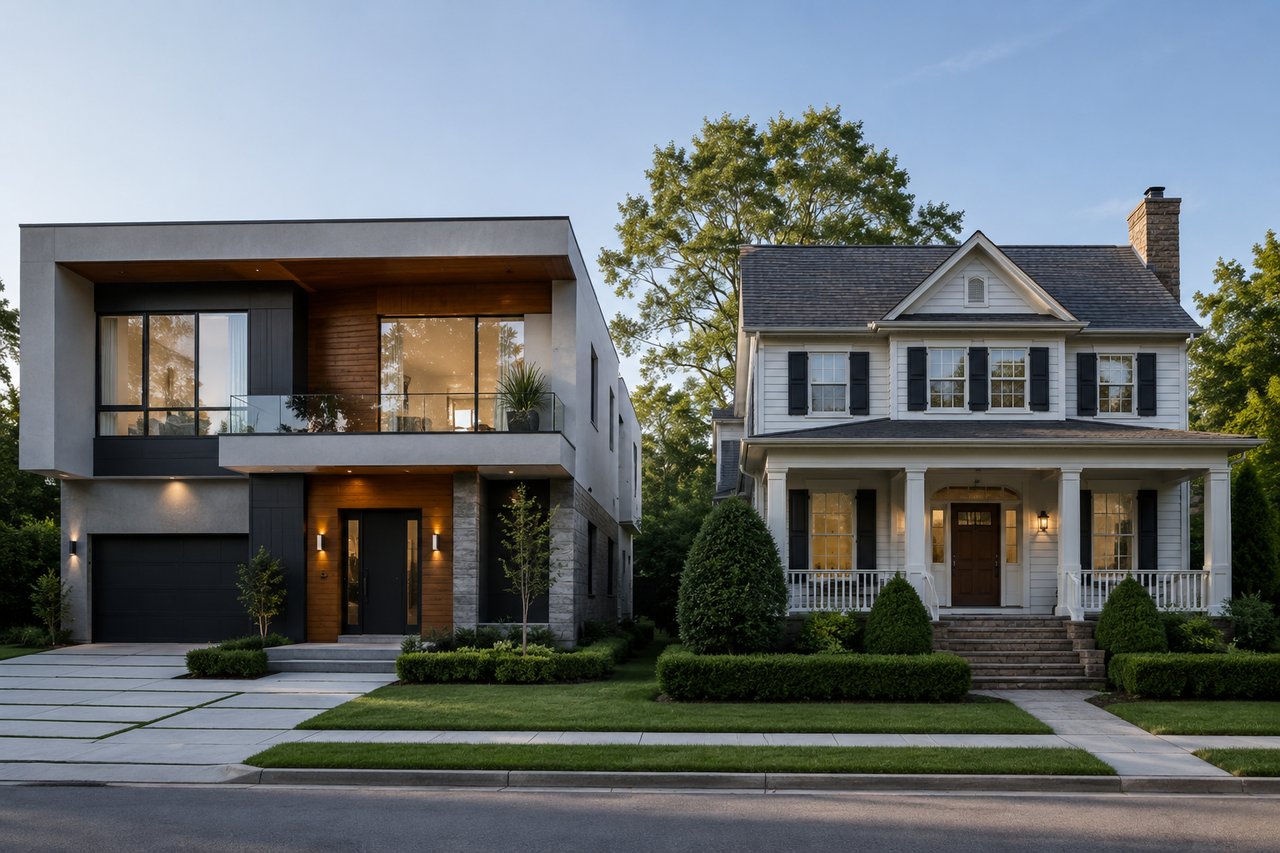
Buyers comparing a clean-lined modern build against a classic center-hall traditional often frame it as a bet: pick the wrong side of a design trend, and resale value suffers. It's a reasonable worry — but it's asking the wrong question.
Nashville's luxury market makes this especially visible right now. Established neighborhoods like Belle Meade, Green Hills, and Forest Hills carry a strong traditional core, while areas like East Nashville, Wedgewood-Houston, and The Nations have filled in with modern new construction over the past decade. Buyers moving between these pockets want to know which style is the "safer" long-term investment.
This guide walks through how appraisers and the market actually treat architectural style, where each style tends to perform best, and what matters more than the modern-vs-traditional label itself.
Key takeaways:
- Appraisers lean on comparable sales, condition, and function far more than aesthetic style — style affects value mainly through how well a home fits its surrounding neighborhood.
- Traditional homes generally draw a broader buyer pool, since their layouts read as familiar to more people.
- Modern homes can command a real premium in neighborhoods where modern construction is now the norm, especially with relocating and lock-and-leave luxury buyers.
- Construction quality and how well a design ages matter more over a 10-20 year horizon than which style label it started with.
Appraisals are built on comparable sales — recently sold homes similar in size, condition, and location. Style enters the picture mainly through the conformity principle: a home that fits the general style and price point of its neighborhood tends to hold value better than the most unusual house on the block, regardless of which direction that difference runs. A strikingly modern home surrounded by traditional estates can be just as hard to comp — and therefore just as exposed on resale — as an overly ornate traditional home dropped into a modern infill block.
Traditional layouts — defined rooms, classic proportions, familiar exteriors — tend to be easier for a broader range of buyers to picture living in. That wider pool tends to work in a seller's favor during softer markets, since there's less reliance on finding the specific buyer who wants exactly that aesthetic.
In neighborhoods where modern construction has become the norm, a well-built modern home can outperform, not lag. Open floor plans, energy-efficient systems, and low-maintenance materials appeal strongly to relocating executives and buyers prioritizing simplicity — a buyer profile Nashville sees often given its steady inbound relocation activity. In those pockets, a modern home isn't the outlier taking the conformity-principle hit; it's the home that matches expectations.
The more common resale problem isn't modern versus traditional at all — it's overly trend-driven execution within either style. Ultra-specific modern finishes (a particular era of matte-black hardware, a very-of-the-moment tile) can date as fast as heavy, ornate traditional detailing. A well-executed, more restrained version of either style tends to age better than a highly trend-forward version of the same style.
Do modern homes hold their value as well as traditional homes?
In most markets, yes — provided the home is well-built and fits its neighborhood context. Appraisers weigh comparable sales, condition, and function far more heavily than style, so a well-maintained modern home in a modern-friendly area can hold value just as well as a traditional home in a traditional one.
Does architectural style affect a home's appraisal?
Not directly. Appraisers compare a home to similar recently sold properties nearby, focused on square footage, condition, and features. Style matters mainly through conformity — a home dramatically different from its neighbors, in either direction, can be harder to comp and may sell for less.
Is it riskier to buy the only modern home on an otherwise traditional street?
It can be, for the same reason a highly traditional home would stand out on a modern block — the conformity principle cuts both ways. It's worth weighing against how deep the buyer pool for that specific style is in that specific neighborhood.
If I'm buying purely with resale in mind, what should I prioritize over style?
Construction quality and neighborhood fit. A well-built home in a style consistent with its surroundings tends to outperform a flashier home that's the outlier on its block.
Is Nashville's luxury market currently leaning modern or traditional?
Both are active, in different pockets — established neighborhoods remain traditional-strong, while redeveloping areas have shifted toward modern new construction.
Do renovations matter more than the original architectural style?
Generally, yes. A dated home of either style tends to underperform a well-updated one — updates to kitchens, baths, and systems typically move the needle more than the underlying style label.
Why work with a local specialist on a style-related resale question?
Conformity and buyer-pool depth vary block by block, not just neighborhood by neighborhood — a local specialist can pull the actual comps for your specific street rather than relying on citywide generalities.
Practical Next Steps
1. Ask for recent comps specific to the neighborhood (and ideally the block) you're considering — not a citywide average.
2. Weight construction quality and layout function at least as heavily as style when comparing two homes.
3. If you're drawn to a style that's the outlier for that neighborhood, ask how deep the buyer pool for that style has been in recent sales there.
4. If selling, invest in making your home's existing style read as well-executed and well-maintained rather than trying to convert it to a different style.
5. Get a second opinion from someone with hyperlocal comp data before treating "modern" or "traditional" as the deciding factor.
Conclusion
The modern-versus-traditional question feels like a style debate, but the resale answer is really about fit and execution: a well-built home that matches its neighborhood's context tends to hold value regardless of which style it wears.
Work With Morrell Property Collective
Whether you're weighing a modern build in East Nashville or a traditional estate in Belle Meade, we can pull the actual comps for your specific street so the decision is based on real numbers, not assumptions about style. Call Morrell Property Collective at (615) 593-3103.

Buyers
A lifestyle gut-check before you start touring downtown Nashville high-rises
Buyers
Why Nashville's most discerning buyers are paying for privacy — and what to weigh before you do
Sellers
Why presentation carries more weight at the top of the market — and what current data actually shows
Buyers
The program is usually pitched to sellers — here's what it actually means if you're the one buying
Nashville
There's no single "best" Nashville neighborhood — just the one that matches what you're actually optimizing for

Nashville
Lakes, trails, clubs, and wine country — the real geography behind Nashville's executive lifestyle
Nashville
Three of Middle Tennessee's best-known luxury markets, compared on price, character, and commute
Nashville
What current data actually shows about buying and selling at Nashville's top end
Neighborhood
Four neighborhoods across Nashville and Knoxville where schools, safety, and space matter as much as square footage
The client deserves the full service and attention that only a team of experts can consistently provide. Working with us, you will have the personal attention traditionally associated with the client-agent relationship improved by the professionalism and consistency of a thoughtful business model. And yes, superior results will follow!
MORRELL PROPERTY COLLECTIVE
(615) 593-3103
[email protected]
ADDRESS
3990 Hillsboro Pike, #320
Nashville, TN 37215